Showing posts with label Google. Show all posts

October 27, 2016

Download Google Pixel, XL USB Drivers (ADB+Fastboot)

If you are trying to connect your phone to USB cable and phones doesn’t show up on your PC, then go ahead and install the drivers listed here.

Visit this link and download Windows ADB, Fastboot and USB Drivers – 15 seconds ADB Installer v1.4.3

1. Once the file is saved on your desktop, The tool is a single “.EXE” application. Run the “adb-setup-.exe” which you downloaded and You will see a welcome screen on your Windows PC.

1

2. Type “Y” and then press enter on the first screen to start the installation of Google Pixel, XL USB Drivers.

3. Again, type “Y” and press enter. To install all the latest ADB and Fastboot files on your Windows PC.

ADB-fastboot-files

4. Once the process will complete and a message will appear on the screen to “Install Device Drivers.” You have to select Yes (Y) here to download and install Google Pixel, XL USB Drivers.

Google-pixel-usb-drivers

5. Once you press enter, the program will automatically detect whether you have a 64-Bit or 32-Bit installation of Windows and launch the driver setup respectively Click NEXT button and start the USB drivers installation on your PC.

6. Now you have successfully installed ADB / Fastboot files along with Google Pixel, XL USB Drivers. Click “Finish” and the installation wizard, as well as the ADB / Fastboot installer tool, will exit.

October 26, 2016

Google Chrome 54.0.2840.71

Chrome_logo

Google Chrome is a browser that combines a minimal design with sophisticated technology to make the web faster, safer, and easier. Use one box for everything--type in the address bar and get suggestions for both search and Web pages. Thumbnails of your top sites let you access your favorite pages instantly with lightning speed from any new tab. Desktop shortcuts allow you to launch your favorite Web apps straight from your desktop. Google Chrome also uses a brand new JavaScript engine (V8), which is much faster than existing javascript interpreters. This means you can create more complex and more intensive AJAX applications with fewer speed and processing constraints. Finally, Google Chrome is built on top of WebKit, so Google Chrome users will benefit from the CSS3 features being added to WebKit as those features are released.

Download web installer: Google Chrome Web 32-bit | Google Chrome 64-bit
Download: Chrome 32-bit Offline Installer | 42.3 MB
Download: Chrome 64-bit Offline Installer | 46.2 MB
Download: Google Chrome MSI Installers for Windows
View: Chrome Website | v54.0.2840.71 release notes

January 21, 2011

Neowin.net - Google Co-Founder Larry Page to take over as CEO

Google announced today that as part of a shakeup in senior management, Eric Schmidt is stepping down from his role as Chief Executive Officer. Schmidt, who has been in the role for the last 10 years, will be replaced by another of Google's co-founders, Larry Page. He will also lead product development and technology strategy. The current CEO however isn't leaving the company and will stay on in an advisory capacity as the Executive Chairman. On the change Mr. Schmidt had the following to say:

We’ve been talking about how best to simplify our management structure and speed up decision making for a long time. By clarifying our individual roles we’ll create clearer responsibility and accountability at the top of the company. In my clear opinion, Larry is ready to lead and I’m excited about working with both him and Sergey for a long time to come.

Google's other co-founder Sergey Brin has decided as part of this shakeup that he will devote his time and energy toward strategic projects, and more specifically new products.

Mr. Page commented on his promotion to CEO saying:

Eric has clearly done an outstanding job leading Google for the last decade. The results speak for themselves. There is no other CEO in the world that could have kept such headstrong founders so deeply involved and still run the business so brilliantly. Eric is a tremendous leader and I have learned innumerable lessons from him. His advice and efforts will be invaluable to me as I start in this new role. Google still has such incredible opportunity–we are only at the beginning and I can’t wait to get started.

The changeover however will not be immediate, and will instead take place April 4th.

December 23, 2010

Woman sues Google over underwear images posted on Street View

A Japanese woman is suing Google over a revealing Street View image, according to a report out of The Telegraph UK. The unidentified woman is asking for 600,000 Yen (US$7163) due to psychological distress caused by the publication of a Street View image that showed her skivvies presumably hanging on a clothesline to dry. According to the court documents, the woman's obsessive-compulsive disorder was exacerbated by the sight of the her underwear on the Internet and her anxiety became overwhelming. Fearing she was being watched and the potential target of a sex crime, she moved from her residence and was fired from her job. 

While her case might be extreme, this is a problem that continues to plague Google's Street View service, especially in Japan. In 2009, Google had to re-shoot parts of the island nation due to the camera height of the Google Street view vehicles. The cameras extended above most of the fences in Japan and captured images of people in their backyards with their laundry hanging on clotheslines.  Enough people complained about the sight of their hanging underwear that Google lowered the camera by 16 inches and re-filmed 15 cities including major cities like Osaka and Tokyo. Unfortunately for this lady and others out there like her, the cameras still caught the occasional embarrassing moment.

December 21, 2010

Google extends free Gmail calling through 2011

In spirit of the holiday season, Google is feeling mighty generous to all of its Gmail users. Google announced this morning that it will extend free calling to all of the United States and Canada, through 2011.

Gmail calling works like a regular phone, but through your email account. You simply select a contact or dial a number, and start talking to the recipient. The free service was originally intended to be cut off at the end of this year, but Google has offered to extend Gmail calling until December 31, 11:59pm 2011.

Gmail calling doesn't just do voice, but it also allows you to video chat with supported webcams and cell phones. Gmail calling also does international phone calls too, for as little as $0.02 a minute.

If you haven't tried Gmail calling yet, give it a try by logging into your Gmail account and selecting "Call phone" on the left hand side. You can also get the desktop client for Windows, Mac and Linux for free here.

November 11, 2010

Google gives everyone a 10% raise, huge bonus

We’ve always heard that Google was a great place to work, and CEO Eric Schmidt is putting his money his mouth is, quite literally. Business Insider reports that to honor the performance and quality of all Google employees, Schmidt announced a minimum 10% raise across the board for 2011; minimum, because employees are also eligible for individual merit increases. And as if that wasn’t enough to put Googlers in the holiday spirit, all employees will also be receiving a $1000 (taxes-paid) cash “holiday bonus.”

That’s a lot of money. Given the company’s 20,000 employees, the cash bonus alone will cost $20 million, and that’s not including the taxes already paid on it. The raise is estimated to cost $1 billion per year.

It’s not like Google doesn’t have the cash, though. The company has been on a revenue roll since its inception in 1998, and it doesn’t seem to be letting up. Their initial gamble in the mobile OS industry has paid off in spades (not in actual OS sales – it’s a free OS – but by having 98% of the mobile search market), and their search engine and browser don’t seem to be letting up in growth numbers. They will be releasing a desktop OS, Chrome OS, in November, and they will be testing the broadband ISP waters next year. 

In an internal memo, Schmidt highlights the quality and motivation of the Googlers as the prime driver for the surprise raise.

...[W]e believe we have the best employees in the world. Period. The brightest, most capable group of this size ever assembled. It’s why I’m excited to come to work every day--and I’m sure you feel the same way. We want to make sure that you feel rewarded for your hard work, and we want to continue to attract the best people to Google.

Googler families can expect some pretty awesome gifts this year.

November 4, 2010

Google Docs to get cloud printing, syncing, and third party apps

Google Cloud Print

Google Docs has undergone some nice changes in the past year. However, none of those changes compare to what Google seems to have in store for its cloud-based office suite. Google Operating System, a website dedicated to uncovering the latest and greatest Google news, has found something interesting in the Google Docs source code.

"Coming soon: Third party applications, cloud printers, and sync devices."

The benefits of third party apps and the ability to sync between devices and the cloud are obvious wins for Google Docs users. The ability to infinitely expand the feature set of Docs, as well as keep all sorts of files synced, will allow for a worry-free environment that just works. But why is cloud printing such a big deal?

When someone prints from a Windows, Linux, or Mac machine, local drivers are required to properly translate and process a print job. This leaves a heavy burdon on the OS and hardware makers. The more platforms out there, the more drivers that need to be created, and the more drivers that need to be stored locally in case of need. Cloud printing removed this issue. Instead of having local drivers, Google is going to house all the drivers on their servers, and your device will simply contact them to make the printing happen. This will also allow users to print to any printer, anywhere. Without too much of a complex setup, printing a document to your friends house could be just a few clicks away. As far as we know, this feature is going to be integrated into Chrome OS.

If rumors are true, and a Chrome OS device is set for release by the end of this month, then it's possible we'll see these new features rolled out within the next few weeks. In order to compete with Microsoft's latest cloud based Office product, Google really needs to step up its game. If the above features are really coming to Google Docs, we can safely say that Big G is on the right track.

November 2, 2010

Google Sues America !

In the latest installment of anti-trust drama in the upper echelons of technology industry giants, Google has filed suit against the United States Government. The complaint is that when the US was looking at options to improve their messaging functionality, they specifically looked for only Microsoft products, and didn’t once take into consideration a Google Apps solution. Google’s argument is that restricting the Request for Quotation to Microsoft Is “unduly restrictive of competition.” It happens to also be unduly restrictive to Google’s financial standing, but that probably wouldn’t fly in court.

The US defends its position by claiming that although Google could have been considered in the RFQ, Microsoft offered two things that Google couldn’t offer in their Google Apps platform: Unified Mail/Messaging, and “enhanced security.” That last security bit probably raised all kinds of hackles over at Google, and they are understandably fighting against that argument trying to convince Microsoft that Google, Apple could very well have been a possibility, and that it was unfair to exclude them from the outset. The official complaint, as provided by Techdirt, outlines a scenario, where, after Google tried to present themselves as a possible provider for the service, the CIO of the Department of the Interior informed them that a “path forward had already been chosen.”

On the off chance that this lawsuit actually goes anywhere in court, we could be seeing an interesting shift in power in the war on government tech contracts. Microsoft has been the de facto choice of the US government (and for most of the world) for quite some time, and if Google can really prove that they could offer a viable solution for government email/messaging, Microsoft may actually have a real fight on their hands.

October 29, 2010

Oracle still suing Google; now with proof

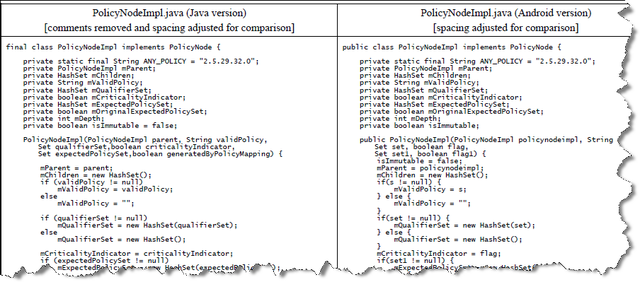
Back in August, Oracle sued Google over alleged use of copyrighted java code in its Android operating system. After Google insisted that the suit was baseless, the case kind of fizzled out. Now, Oracle is revising their original suit to include line by line examples of patent infringement by Google, as shown by ZDnet.

Image Source: ZDnet

While the code is slightly different in places, Oracle believes that the comparisons exhibited are “nearly identical…on a line-for-line basis.”

Christopher Dawson, writing for ZDnet, believes that Oracle’s play on Google is not just about money. While Oracle’s monetization of Sun has a lot to do with filing suit on IP claims whenever possible, Dawson believes that Oracle really wants a piece of the mobile market. Considering the potential PR backlash that suing a company like Google entails, he believes that there is a broader tactical strategy behind the suit other than pure cash settlements. In fact, the Wall Street Journal is confused about the whole lawsuit in the first place. Why would Oracle go after Google, of all companies? There are plenty of smaller fish to fry in the wide world of Java development. This only furthers Dawson’s point that Oracle is looking to force Google into some kind of deal that latches them onto the back of the mobile computing revolution that Android is a big part of.

October 25, 2010

Google pays only 2.4% in taxes through loopholes

Bloomberg took a close look at Google's regulatory filings and found that over that last three years they have been able to cut $3.1 billion in taxes, thanks to loopholes in the system. They are using a technique that moves the money from Ireland and the Netherlands to the tropical island of Bermuda.

The income shifting strategy, known in the legal world as the Double Irish and the Dutch Sandwich, is a legal way to shift income overseas to avoid paying any taxes on it. Google was able to shift enough money around to lower its overseas income to just 2.4%. Martin A. Sullivan, a tax economist said:

It’s remarkable that Google’s effective rate is that low.  We know this company operates throughout the world mostly in high-tax countries where the average corporate rate is well over 20 percent.

Using Bermuda as a tax shelter to avoid paying taxes on income is beginning to pick up steam among tech companies. It is said that Facebook and Microsoft are beginning to take advantage of these tax loopholes.

The loophole itself takes advantage of an Irish law that allows companies to legally move money between subsidiaries helping to escape Ireland's 12.5% tax. So these companies take income and move it to the islands where there is no corporate tax. This then lowers the amount of taxable income within countries like Ireland that allow money to be shifted tax free. Jane Penner a Google spokesperson defended the practice saying, "Google’s practices are very similar to those at countless other global companies operating across a wide range of industries” 

October 23, 2010

Google admits it also stole emails and passwords

Google has been under investigation for the past couple of months for 'accidentally' stealing WiFi data on its Google Street View cars. The cars were designed to take snapshots of streets to help improve its feature, expanding it to additional countries including Canada and Germany. The data was captured through an experimental project that Google accidentally included in its street view cars.

However, the Google street cars took more than just photos, it also took personal information, like user IDs. According to a report by Reuters, Google stole more than just the details it originally claimed, it also captured full emails, URLs and even passwords.

The original report left out these important details, and some countries have even allowed Google to delete this data, including the UK. The Canadian privacy commissioner is still investigating the matter, as Google did break Canadian privacy laws.

Google did claim that some of the data collected was fragmented, because the cars were always moving, but some information that was captured was complete. Google went on to say that it was enhancing its privacy training for their engineers and important groups within the company.

October 22, 2010

Google no longer records Wi-Fi information

Google has finally admitted that they will no longer use their Street View cars to snap up details of users' wi-fi networks that it passes along the way. Google had stated that they only used the data for geolocation tasks to show where a user was based.

However, they will continue to use some of their software that tracks you, such as My Location for similar tasks as well as using mobile phone data for the same thing.

The news that Google’s Street View cars was picking up user wi-fi data on its journeys caused outrage amongst privacy campaigners when details about it first leaked, despite Google saying that it wasn’t being used for malicious means. They did admit that the cars were mistakenly collecting samples of payload data from open wifi networks.

Google originally blamed the collection on an old piece of legacy code that had been used in its Street View cars that has now been removed.

CNet quoted Candian privacy commissioner Jennifer Stodart’s report on the incident as the source of the news. The report made note that Google no longer collects data and have no further plans to do so.

October 15, 2010

Google announces $1 billion in mobile revenue

Google revealed in its third-quarter earnings call that the search giant is on track to bring in $1 billion this year in mobile revenue and expects continued strong growth in the mobile market.

Google Chief Financial Officer Patrick Pichette prefaced the metrics by emphasizing that the company was making the product specific breakdown available on a "one-time basis."

"I need to make it very clear that we will not be updating these numbers going forward. We are merely sharing them with you as a proof point of the great momentum we're experiencing in our emerging businesses," said Pichette.

"Mobile revenue is on an annualized run rate of over $1 billion," said Jonathan Rosenberg, senior vice president of product management at Google. Search queries from mobile devices have grown 5 times over the last couple of years, with most of the queries coming from Android phones, Rosenberg noted.

Google is placing a heavy emphasis on the emerging mobile market. Mobile "is the future of search in the internet," Rosenberg said. Recent smartphone sales data shows that the Android mobile operating system is outselling Apple's iOS.
The $1 billion news comes as a rare glimpse into Google's share of mobile profits. In late September, IDC reported that it expects Apple to match Google with 21 percent of the mobile ad market share by the end of the year. A Google spokesperson declined to respond with figures of its mobile ad sales for the year, but assured that Google was "experiencing fast growth" in mobile ad revenue this year. "If we are losing share, this market is growing faster than any one we've ever seen," said Jason Spero, director of mobile for the Americas at Google.

When Apple Chief Executive Steve Jobs announced the iAd mobile advertising program, data from JP Morgan revealed that projected iAd revenue for the second half of 2010 could give Apple as much as a 50 percent share of the emerging market. The iAd platform will receive a substantial boost in November when it comes to the iPad on iOS 4.2.

Yahoo Chief Executive Carol Bartz believes iAd will "fall apart" as Apple's high level of control drives away advertisers. Adidas is rumored to have canceled a $10 million iAd contract because Apple had exerted too much control over the process.

Not everyone's experience of iAd has been negative, though. Nissan and Unilever both told the Los Angeles Times in August that they were pleased with the initial performance of the iAd network.

"We feel pretty strongly that this is the way to capitalize on where the mobile Web is heading," Chad Jacoby, senior manager of Nissan's media operations, reportedly said.

For its part, Apple will report its quarterly revenues on Monday, Oct. 18 at 5 p.m. Eastern, 2 p.m. Pacific. Whether the company will also release specific figures for mobile revenue remains to be seen.

October 13, 2010

Google helps invest $5billion into offshore wind project

On Monday, Google announced on their official blog that they are investing into a transmission backbone that could potentially power 1.9 million households.

Google will partner with a New York financial firm to invest an estimated $5 billion into the project. The Atlantic Wind Connection (AWC) backbone will stretch from New Jersey to Virginia – a whole 350 miles and connect 6,000MW of offshore wind turbines, equating to 60% of the wind energy installed throughout the whole of the US last year.

The AWC backbone is to be situated in the Mid-Atlantic which could potentially create 60,000 MW of power because of the shallow waters. The shallow water extend miles out to sea which Google say “make it easier to install turbines 10-15 miles offshore, meaning wind projects can take advantage of stronger winds and are virtually out-of-sight from land.”

For those wondering why they chose offshore wind in the Mid-Atlantic, they later said “Many coastal areas in the United States have large population centers on an overstretched grid but limited access to a high-quality land-based wind resource. These coastal states can take advantage of their most promising renewable resource by using larger wind farms with larger turbines that can take advantage of stronger and steadier winds offshore.”

Google is investing 37.5% of the equity in the initial development stage in order to gain the needed approval to start construction. The construction is thought to start in 2013 and be finished by 2021.

In May, Google announced that they had invested $38.8 million into two American wind farms which are able to churn out 169.5 MW of power - enough to power 55,000 homes. The company have also stated that they are aiming to be a carbon neutral corporation.

October 10, 2010

Microsoft Office web apps surpasses 20 million users

Earlier this week, Microsoft announced that they have surpassed 20 million users on their Office Web Apps. Microsoft released their web apps in the summer, which included Word, Excel and PowerPoint.

Microsoft was largely unchallenged in office document processing for many years, until Google stepped in three years ago and offered their own version of Word, Excel and PowerPoint, called Document, Spreadsheet and Presentation. Google Docs became a success because it was free, online and easily tied in with your gmail account.

Google Docs currently has over 25 million users, but in a few short months, Microsoft is hot on Google's trail with over 20 million users, according to The Seattle Times.

Microsoft Office Web Apps easily integrates with your Windows Live ID and a number of online services from Hotmail, Facebook and live.com. Docs.com also integrates with your SkyDrive, which offers up to 25GB of storage, can be accessed anywhere with an Internet connection.

Microsoft Office Web Apps can also be downloaded to your desktop and used with Microsoft Office, unlike Google Docs, which is strictly online. Like Google Docs, users can share documents with anyone online, allowing friends to make changes to your documents.

Google engineer on WP7: The world doesn't need another platform

In an interview with PCMag (via Engadget), Google engineer Andy Rubin discussed Android, market fragmentation, and even Windows Phone 7. In what was probably a spur of the moment statement, Rubin stated that he thinks that the world doesn't need yet another mobile phone platform. The way Rubin sees it, the only reason someone would even try to create a new platform is for political reasons. Maybe he has a point. More OS's mean more fragmentation in the market, more phones that developers have to choose between, more chances of incompatibilities, etc. Many of us clearly remember the pre-Windows world of desktop computing and the annoyance that came with finding out that you can't get the software you want on your machine.

When Android was first announced, Apple's iOS was taking the world by storm, Blackberry was getting into the ‘touch' scene, Symbian was doing OK, and Microsoft had a small share too. At that stage no one knew they needed Android, and there were already plenty of OS options. Since that time, the market has become even more complex with Samsung throwing in a new in-house OS (Bada), and soon Microsoft's going to be launching their Windows Phone 7 platform - but it's still Windows Phone. Microsoft's replacing the old Windows Phone with a new (very different) version, they're not a new player with a new brand. Claiming that the world doesn't need another phone OS seems a little strange to me when you work for a company that made a completely new OS, and you're trying to brush-off a competitor that's heavily revising their OS.

On the topic of fragmentation, Rubin shared the views of most consumers and claims to want OEMs to use the latest Android versions instead of out-dated builds. Of course, Google's long-time competitor Microsoft would be able to tell them a few stories about OEMs not giving up on old software versions. In fact, Windows XP might be the case study that Google needs to learn from. The biggest reason for XP's prolonged (zombie-like) existence isn't because people don't like change, and it's not because people don't want to upgrade their hardware. It's because so many companies put so much time and effort into building applications for XP - and it takes a long time for those companies to decide that it's worth the money to rewrite huge amounts of code. Android, which has gone through a number of version changes since birth, may be suffering from a similar fate. Perhaps Google's way out of the fragmentation mess is to change is to give developers more of heads-up, that way they'll be able to code with future changes in mind and not be stuck with a customization that only works on one build.

What do you think about Andy Rubin's comments? Is Windows Phone 7 going to add that much more confusion into the mobile marketplace, or is it already so full of competition that it won't matter?

October 9, 2010

1-800-GOOG-411 shutting down in November

Google has announced, via their official blog, that they are shutting down their automated directory assistance service, 1-800-GOOG-411, on November 12. GOOG-411 was launched in 2007 and was the first service to use speech recognition offered by Google.

Google is making the change because many cell phone users are moving to smartphones with internet access and they no longer need to dial 411 to get contact information. For those that don't have a smart phone they still offer the option to text the business name and location to 466453 ("GOOGLE") and they will text back the contact information.

The technology behind GOOG-411 isn't going away though, it provided the foundation to some of their other offerings such as:

  • Voice Search - search Google by speaking instead of typing.
  • Voice Input - fill in any text field on Android by speaking instead of typing.
  • Voice Actions - control your Android phone with voice commands. For example, you can call any business quickly and easily just by saying its name.

Google is still working to improve their speech recognition offerings, saying they are aiming for more innovation and are putting all of their resources into speech enabling applications across multiple languages for the next generation of Google products and services.

October 8, 2010

Google and Hulu in talks about Google TV integration

Not a ton of details on this one, but Logitech's Junien Labrousse just responded to a question about possible Hulu integration in Google TV by saying that while Hulu is now actually blocking the box, Google and Hulu are currently in talks about bringing the service to Google TV -- and, well, that's about it. Missed out on the event? Be sure to check out our liveblog and our coverage of Logitech's complete Google TV lineup.

October 2, 2010

Google announces new photo format: WebP

Google is pushing for the future of photo formatting to be done in WebP, leaving JPEG in the dust.

WebP (pronounced weppy) has been under development by Google and reduces file sizes by 40 percent compared to JPEGs. That means faster downloads from websites and less strain on networks.

Richard Rabbat, product manager at Google explains why they made the decision to develop WebP, “Most of the common image formats on the web today were established over a decade ago and are based on technology from around that time. Some engineers at Google decided to figure out if there was a way to further compress lossy images like JPEG to make them load faster, while still preserving quality and resolution. As part of this effort, we are releasing a developer preview of a new image format, WebP, that promises to significantly reduce the byte size of photos on the web, allowing web sites to load faster than before.”

Google is working hard to make this a new standard and has been in discussions with browser developers to gather support. Not surprisingly, we can expect to see WebP support in Chrome in the next few weeks.

September 30, 2010

Picasa 3.8 Build 115.66

Picasa is software that helps you instantly find, edit and share all the pictures on your PC. Every time you open Picasa, it automatically locates all your pictures (even ones you forgot you had) and sorts them into visual albums organized by date with folder names you will recognize. You can drag and drop to arrange your albums and make labels to create new groups. Picasa makes sure your pictures are always organized.

Picasa also makes advanced editing simple by putting one-click fixes and powerful effects at your fingertips. And Picasa makes it a snap to share your pictures, you can email, print photos home, make gift CDs, instantly share your images and albums, and even post pictures on your own blog.

The latest version includes Web Albums (along with other improvements), but requires that you request an account from Google

Changelog:

* Fixed "Manage Online Contacts" 403 errors.
* Fixed corrupt metadata bug.
* Fixed various Face Movie crashes.
* NEF files appear again for mass storage devices on Windows 7.

Download: Picasa 3.8 Build 115.66 | 10.4 MB (Freeware)
View: Picasa Website